

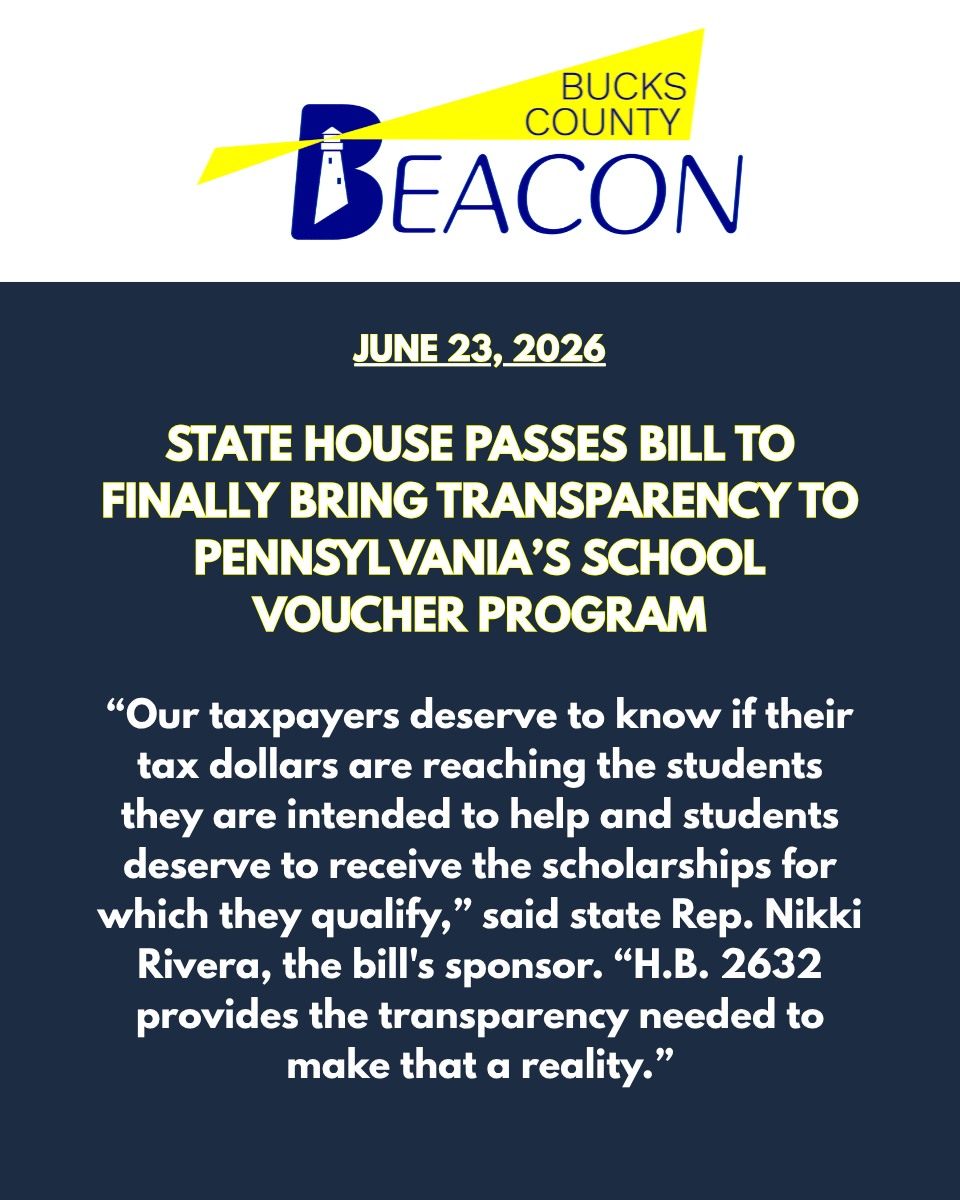
House passes HB 2632, bringing transparency and accountability to scholarship programs

On Monday, the House passed House Bill 2632, a bill that brings transparency and accountability to Pennsylvania’s Educational Improvement Tax Credit (EITC) program while expanding access for students most in need and ensuring that tax dollars are used effectively and efficiently.
Right up until the time of the vote, the Commonwealth Foundation and other special interest organizations continued their disinformation campaign against the bill, with deceptive text messages and email campaigns that preyed on the understandable concerns of families whose students or private and parochial schools are supported by EITC scholarship funds.
Here are the facts:
Right now, Pennsylvania diverts $680 million in tax dollars every year into private school scholarships with almost no transparency. We do not know which corporations are taking the tax breaks, which schools receive the funding, which students benefit, or whether the program is effectively serving low-income students.
The current EITC framework allows donors to profit from tax incentives through a process called “triple-dipping.” Here’s how it works: EITC scholarship donors receive a tax credit averaging 90% of their contribution amount. Taking advantage of tax loopholes, they can also use their donation to reduce their federal and state tax liability, resulting in as much as a 27% profit from their contribution, all at the expense of Pennsylvania’s taxpayers.
They’ve gotten away with it because current EITC laws prohibit us from collecting data on where and how these dollars are being spent, or whether that expenditure is ultimately beneficial for the students EITC programs were intended to help.
HB 2632 does not cut a single dollar from EITC scholarship programs. All $680 million currently allocated to the program remains intact. There are no cuts to scholarships.
What HB 2632 does is create accountability for the hundreds of millions of dollars flowing through Pennsylvania’s private scholarship tax credit programs.
It requires that organizations receiving donations eligible for tax forgiveness through EITC voucher programs report how those dollars are being spent: who gets scholarships, how much, and where the money goes.
It creates transparency by requiring state audits and an independent fiscal review.
It expands eligibility for Pre-K scholarship programs to children ages 0-2.
It expands opportunities for the students with greatest need by removing the per-pupil cap for the lowest-income students.
For years, EITC scholarship money has been handed out with minimal public oversight, allowing wealthy donors and corporations to profit from tax credits, while working families and seniors face soaring property tax increases to make up the difference. HB 2632 would create that much-needed oversight, and that is what the opposition to this bill has always been about.
I support HB 2632 because I believe that if you have to pick up the difference for tax breaks, you have a right to know who those tax breaks are helping and whether the programs incentivized by the tax breaks are serving the students they claim to serve.
I attended Catholic school for 11 years. My parents, siblings, cousins, and many extended family members are products of Catholic schools.
Scholarships for private and parochial schools have existed for all time. What has not existed for all time are tax schemes that allow billionaires to profit from these scholarship programs. My working-class parents paid for my religious education and no one gave them a break on their income tax or property tax requirements. Any scholarships I received were funded by the diocese or through private donors, and no one received a tax credit. That’s the way the system worked until 2001, when the EITC scholarship program was created, giving corporations and wealthy donors a way to profit from tax incentives while the burden of funding our constitutionally mandated public schools shifted disproportionately to working families and seniors in communities like Coatesville and West Brandywine. .
There is nothing in HB 2632 that would prevent the sorts of donations that helped to support my Catholic school education or the private school educations of generations of Pennsylvania students. No one is stopping any private entity from giving a single dollar to a scholarship organization or donating directly to a private school.
Instead, HB 2632 creates true accountability and transparency around how $680 million in taxable funds are redirected by corporations to reduce their tax bills, and how hundreds of scholarship-granting organizations disburse that money to schools.
HB 2632 ensures:
We know where tax dollars are going
We know which students benefit and which are left out
We know how much tuition families still have to pay, even after scholarships
We know how administrative allowances are spent
We know whether these programs actually help low-income students
The special interest groups’ real objection to this bill was never about the scholarships or the best interests of students and families.
It has always been about the accountability measures in the bill, which would make it harder for wealthy corporations to profit from tax incentives subsidized by working families and seniors.
I voted in support of HB 2632 because it closes those gaps and provides the oversight taxpayers deserve. The bill now heads to the Senate for consideration.